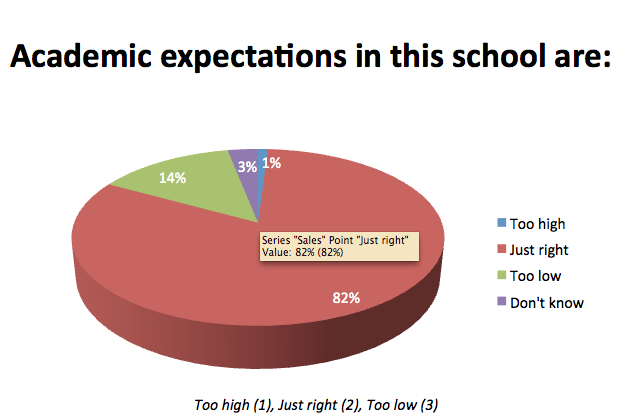
One consistent finding of academic research is that high expectations are the most
reliable driver of high student achievement, even in students who do not have
a history of successful achievement. Much of this research has been conducted
to test, confirm, or debunk the famous “Pygmalion” study in which teachers
were told that randomly selected groups of students had been proven through
testing to be on the brink of great academic gains. Those groups of randomly
selected students in fact outperformed other randomly selected groups whose
teachers had not been led to expect great things, presumably because of those
expectations.
One of the problems with findings about high expectations is that they often
include in the definition a wide array of actions, beliefs, and operational strategies.
One study defined high expectations as including the decision to allocate and
protect more time on task in academic subjects. That’s certainly good policy,
but from a research standpoint, it’s hard to disaggregate the effect of more time
on task from expectations. It’s also hard to turn that into specific action in the
classroom.
So what are the concrete actionable ways that teachers who get exceptional
results demonstrate high expectations? This chapter looks at five, derived from
these teachers, that raise expectations and differentiate great classrooms from the
merely good ones.
TECHNIQUE 1
NO OPT OUT
One consistency among champion teachers is their vigilance in maintaining the
expectation that it’s not okay not to try. Everybody learns in a high-performing
classroom, and expectations are high even for students who don’t yet have
high expectations for themselves. So a method of eliminating the possibility
of opting out—muttering, “I don’t know,” in response to a question or perhaps
merely shrugging impassively in expectation that the teacher will soon leave you
alone—quickly becomes a key component of the classroom culture. That’s where
No Opt Out started, though as with so many of the other techniques in this book,
it soon found additional applications as a useful tool for helping earnest, striving
students who are trying hard but genuinely don’t know the answer. No Opt Out
helps address both. At its core is the belief that a sequence beginning with a
student unable (or unwilling) to answer a question should end with that student
giving the right answer as often as possible, even if it is only to repeat the correct
answer. Only then is the sequence complete.
KEY IDEA
NO OPT OUT
A sequence that begins with a student unable to answer
a question should end with the student answering that
question as often as possible.
In its simplest form, No Opt Out might look like this. It’s the first day of
school, and you’re reviewing multiplication facts with your fifth or perhaps sixth
graders. You ask Charlie what 3 times 8 is. Glancing briefly and impassively at
you, Charlie mutters, “I dunno,” under his breath, then sucks his teeth, and turns
his head slowly to look out the window.
It’s a critical moment. Students all too
commonly use this approach to push
back on teachers when their unwillingness to try, a lack of knowledge, or
a combination of the two makes them
unsure or resistant. And all too often it
works. Reluctant students quickly come to recognize that “I don’t know” is the
Rosetta stone of work avoidance. Many teachers simply don’t know how to
respond. The result is a strong incentive for students to say, “I don’t know”
when asked a question. If you don’t feel like working hard, those three words
can save you a lot of effort. So if Charlie successfully shows you that you can’t
make him participate, it’s going to be a long year of you gingerly (and weakly)
stepping around him, of other students seeing that Charlie does what he wants,
and of Charlie not learning—a lose-lose-lose situation.